
The Idaho Current Owner Card
Every parcel in Idaho has a name attached to it. That name usually surfaces first in the county assessor's roll. The roll lists tax parcels with an owner field. So it is the fastest way to find the current owner of an Idaho property. It answers the tax question, though, not the title question. A deed can be recorded before the roll catches up. So to check who owns an Idaho parcel now, compare the county roll with the newest recorded deed for the same legal description. Anyone who wants to search Idaho property records by county can start with the assessor. Then confirm with the recorder.
| Owner | The name or entity carried on that county's assessor roll. |
|---|---|
| Mailing Address | The address for tax or owner correspondence; it can differ from the land's location. |
| Situs / Property Address | The location address, which may be blank or unavailable for a parcel. |
| Parcel Number / PIN and AIN | County parcel identifiers; formats and use vary across Idaho. |
| Legal Description | The written land description used to compare the parcel with the recorded instrument. |
| Last Updated | A dated marker if the county displays one; it is not a statewide update promise. |
| Latest Deed | Confirm separately in the county recorder index; this may not be a parcel-card field. |
An official Kootenai assessor detail view shows how one county groups general information, legal descriptions, and value history on a single page for each parcel.
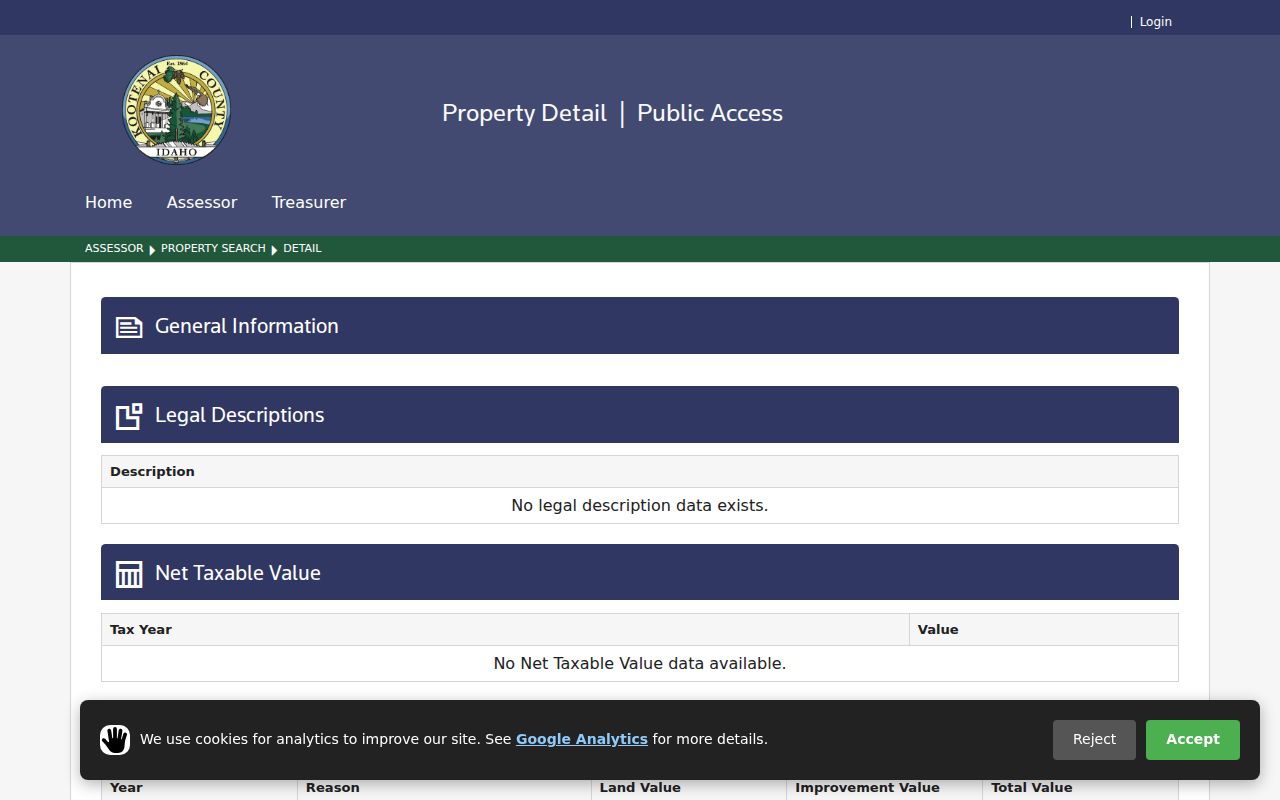
On that Kootenai detail page, each topic sits in its own panel. A blank panel is common. It only means that field is empty on that display. It does not tell you the county records lack the data altogether. Nor should one county's layout be assumed for other Idaho assessor cards.
Idaho Mailing and Situs Fields
Two addresses appear on most parcel cards, and they answer different questions. The situs address says where the land sits. The mailing address says where assessment and tax notices go. They differ for ordinary reasons. An owner picks a separate mailing location, an entity takes mail through an office, or rural land simply has no street address. A mailing address can even fall outside Idaho. So it should never be labeled the owner's home or place of occupancy.
When a card shows both fields, compare the property address and legal description against the map or deed reference. If the address is blank, lean on the parcel ID and legal description. That keeps the record distinct. If the two addresses differ, keep both values with their field labels. That small habit stops a tax-notice destination from being mistaken for the land itself.
Note: An Idaho assessor mailing address is a correspondence field and does not establish where an owner lives or occupies property.
Reading Idaho Owner-of-Record Fields
The owner field answers a narrow question. Which name does the assessor carry for this parcel right now. That name may belong to a person, a trust, a company, or another legal entity. Rolls often add class, acreage, district codes, values, exemptions, permits, and sales history. Those panels help identify the parcel. They do not all establish title. Keep the name, the identifier, and the full legal description together whenever you verify a current owner. A Kootenai sample shows why this matters. That card named a limited liability company. It carried a mailing address separate from the property location. It also listed PIN, AIN, class, acreage, district, and legal-description fields. Those are one county's examples, not a statewide schema. Other Idaho assessor cards use different labels or drop fields entirely. When an LLC or trust appears in the owner field, the roll still names the record holder only. It does not reveal who controls or benefits from the entity. Never swap the public field for a guess about a person behind it. The roll is a matching tool. It is not a full ownership structure.
How Current Is Idaho's Owner Roll
Timing is where assessor rolls fall short. A deed can be recorded well before the owner field changes. Idaho publishes no statewide rule for how many days or weeks that gap lasts. Each county runs its own system. A precise statewide lag cannot be stated. When a card shows a last-updated date, read it as the date attached to that record or page. It is not a promise that every transfer has been processed. One Kootenai detail card, for instance, displayed a July 25, 2025 last-updated date. That proves a dated field can appear on a Kootenai card. It proves nothing about how fast Kootenai posts new transfers. It says nothing about other Idaho counties' update cycles. For a recent sale, put the roll beside the latest recorded deed for the parcel. A recording date can show the deed is newer than the assessor display. The county can explain a mismatch in its own record. Never estimate the delay from a single card. A roll's age does not mean no deed exists.
Note: Idaho's statewide research did not identify a fixed owner-update lag, so a sample card cannot supply one.
Confirm Idaho's Current Owner
Confirming a current owner takes two sources. Use the assessor entry to identify the parcel. Then pull the newest recorded conveyance for that same land. Keep the comparison in the present: latest deed versus the parcel's current assessor entry. If the two disagree, the newest recorded deed is stronger. It is the stronger ownership evidence of the pair. The county assessor can say when its roll will reflect the change.
- Open the county assessor record and capture the owner field, PIN or other parcel ID, full legal description, and any last-updated date.
- Use the county recorder's official search route to locate the latest recorded deed by the available parcel, party-name, or legal-description terms. The Kootenai recorder search entry is one county example.
- Compare the deed's grantee, the party named as recipient, and legal description with the assessor parcel. Check the recording date and instrument number, the county's ID for the recorded document, rather than relying on a name match alone.
- If the deed describes a different tract or a correction is referenced, ask the county office which current record applies before treating the roll entry as settled.
- Owner of record
- The name a particular public record system carries for a parcel.
- Assessment roll
- The county's tax record for assessed parcels and related owner fields.
- Situs address
- The location address for the land or improvement.
- Mailing address
- The destination for tax or owner correspondence, which can differ from the situs.
- Recording lag
- The time between a deed recording and a later change to the assessor's display; Idaho has no single documented statewide interval.
- Grantee
- The party named as receiving an interest in a deed.
For the recorded-document search and copy routes, use the Idaho deed records instructions.
Idaho Entity Owner Names
A tax roll may list a person, an LLC, a trust, or another legal name. It shows the current owner that way. The assessor field reports the name tied to the parcel. It does not automatically identify the individual behind an entity. Keep the displayed spelling, punctuation, and suffix intact. Compare it carefully with a recorded deed. A shortened company name or a similar trust name can point to a different record.
The assessor name and the deed name may differ. If so, compare the parcel's full legal description with the deed's grantee wording. A name variation may need clarification from the county office. Do not infer who controls a trust or LLC from the public owner label alone.
Find the Idaho County Assessor
No single assessor portal covers current owner records for every Idaho county. The Idaho State Tax Commission's property-tax contact directory routes assessment questions to the right county assessor. The Commission itself holds no specific property information. It sends tax-bill questions to the county treasurer and GIS questions to the county. Treat this statewide page as an office handoff rather than a statewide owner search.
Kootenai County serves as the worked example here. Its Kootenai County Assessor page links to a parcel-information search. Each parcel-detail screen carries county-specific fields. For any other Idaho county, start at that county's own official assessor page. Confirm its public search and its contact routes there. Kootenai's PIN length, AIN, labels, and record layout belong to Kootenai alone. Leave them behind when you switch counties.
Sometimes an online entry will not settle an owner question. Give the county office the query and the identifier you already tried. If a deed match stays murky, ask the recorder about in-person or mail research. Kootenai's published records research instructions show one county's approach. A focused question about a parcel, a field label, or an update date beats a request built on an unverified address.
What the Idaho Roll Cannot Prove
An owner-of-record entry is not a title opinion. It cannot prove possession, legal authority to sign, or a clean lien status. It does not fix the boundary on the ground either. The assessor administers property for tax purposes, while the recorder preserves the instruments themselves. A name and parcel match makes a strong starting point. But it never replaces reading the recorded deed.
Check the newest deed. The roll can lag a recently recorded sale, and no statewide update interval was documented. Match the latest county deed to the parcel's legal description before treating the assessor owner as current.
The wider address-to-owner method sits on the Idaho owner lookup page. For the current-owner question, keep the comparison tight: the present assessor entry, the present parcel identity, and the newest relevant recorded deed.