
Idaho Property Value Comparisons
Value figures make sense only when tied to the record behind them. The assessor's number is a market estimate. It is built for taxation. Exemptions carve that figure down to a net taxable amount. A sale price reflects a single transaction reported to the recorder. The three numbers can overlap. Yet none of them substitutes for another.
| Value type | What the number means | Record to check |
|---|---|---|
| Assessed market value | The assessor’s estimate of what a typical buyer would pay as of the valuation date. | County assessor’s parcel record |
| Net taxable value | The taxable base after a qualifying statutory exemption is applied. | Assessor’s value and exemption record |
| Last sale price | A reported transaction figure, if the sale record exposes it. | Recorded deed or county sales-history field |
| Land and improvements | Separate value components for the site and structures. | County assessor’s detail record |
Idaho law puts assessments at full market value. Statutory exemptions then shrink the taxable base. The net figure is not a second appraisal. The tax bill sits further downstream still. A recorded sale price marks a single deal at a single moment. It may diverge from a mass appraisal built on parcel facts and comparable sales. Exemption details, appeal steps, and the bill itself belong with Idaho property tax records. They sit with the county treasurer or assessor.
Idaho Assessor Value Fields
An Idaho assessor record can hold several numbers worth reading together. Kootenai County's inspected detail record lists net taxable value and value history. It also covers exemption history, land details, improvements, commercial data, permits, and sales history. General information and legal descriptions appear there too. Other counties choose their own portal labels, so follow the headings on the local record. A date-last-updated stamp matters. Note it whenever the record shows one. The Kootenai County assessor detail page is the source for this example. It shows the value and parcel headings described here.
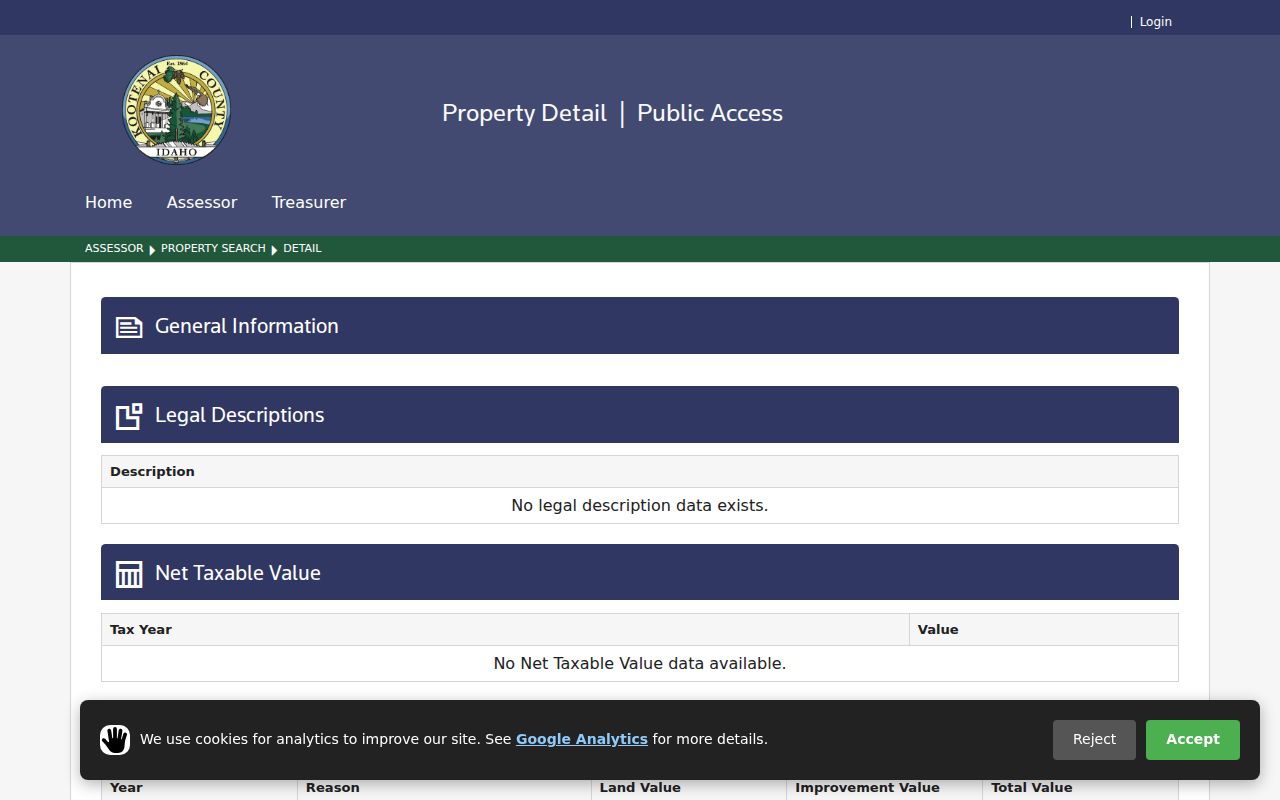
One screen does not define a statewide schema. This Kootenai County example carries a value history spanning 2020 through 2025 and a last-updated date of July 25, 2025. Read the year beside each amount. Read the component beside it too. A land figure plus an improvement figure shows how the assessor assembled the total. An exemption-history entry explains why net taxable value may sit lower than market value. A sales-history heading does not promise that a price is visible on the public page. Treat a blank or collapsed field as blank, not as proof that nothing exists.
Look Up Idaho Property Value
No statewide assessor portal covers parcel-level valuations in Idaho. Start instead with the county assessor for the parcel's home county. The Tax Commission's property-contact list routes visitors to those local offices. The county's own search delivers the parcel-level value fields. The Kootenai County assessor search shows one county's approach. But its controls are not standard across Idaho.
| Kootenai search field | Input | Search guidance |
|---|---|---|
| Parcel Number / PIN | Text; required in PIN mode | Enter the full 12-digit PIN and remove dashes. |
| Owner | Text; mode-dependent | Last name first; fewer characters or the * wildcard can broaden matches. |
| Property Address | Text; mode-dependent | Spell out the street name; the county advises “Mountain” rather than “Mount.” |
| AIN | Text; mode-dependent | Use the six-digit alternate identifier. |
| Legal Description | Text; mode-dependent | Subdivision and lot, or section, township, and range; exact interactive subfields are not stated in the static page. |
- Use the Idaho county property-tax contact list to find the assessor for the parcel’s county.
- Search the county portal by street address or a parcel identifier; if the county is Kootenai, its assessor accepts a full 12-digit PIN without dashes or a six-digit AIN.
- Open the detail record and note assessed or market value, net taxable value, land and improvement components, exemption history, and the year or update date shown.
- For a transaction comparison, check the recorded deed or an exposed county sales-history entry and keep its date separate from the assessment year.
- Assessed market value
- The assessor’s estimate under the state’s assessment standard.
- Net taxable value
- Value after statutory exemptions are applied for tax purposes.
- Assessment level
- A comparison of assessed values with sale prices across a group of properties, used for review of assessment level and uniformity.
- Sale price
- The amount reported for a transaction, when the deed or county record shows it.
- Reassessment
- A later valuation cycle or update; it does not mean every portal field changed on the same date.
Prefer an address-first route that begins with a parcel match? The state's regular Idaho property search handles that side of the task. Then step back into the county value record for the year. From there, pull the land and improvement components. A statewide map can help place a property, but the assessor remains the parcel-level source.
Idaho's Assessment Cycle
Idaho assessors estimate what a typical buyer would pay as of January 1. Size, location, quality, age, condition, and comparable sales can inform that estimate. The result is a mass appraisal across many parcels, not an individual inspection or a quote for a buyer. Read the assessment year beside the number, then compare it with the prior years in the same county record when they are available.
Idaho law and Tax Commission guidance use a market-value standard. The state’s ratio-study manual says counties must appraise all property at least once every five years, but this does not mean every parcel portal field updates on the same day or that market conditions remain fixed between cycles. A new building, a changed condition, or a shift in local sales may matter to a later assessment, while the assessor’s displayed history can retain older values for comparison.
For a change that seems wrong, first separate a factual error from a difference of opinion. Check the parcel, land and improvement components, legal description, class, and year. The tax record and appeal process are covered with Idaho property tax records; this value page stays with what each figure means.
Idaho Assessment Ratio Studies
Idaho's ratio studies compare assessment amounts against sale prices. They measure assessment level and uniformity for the State Board of Equalization. In effect, they test how groups of assessments relate to observed transactions. They are not a parcel-level appraisal. They will not tell you what one home will sell for. A statewide comparison can flag the need for review. But the county record still governs any specific parcel. The Idaho Tax Commission ratio-study page explains the state's comparison method and purpose.
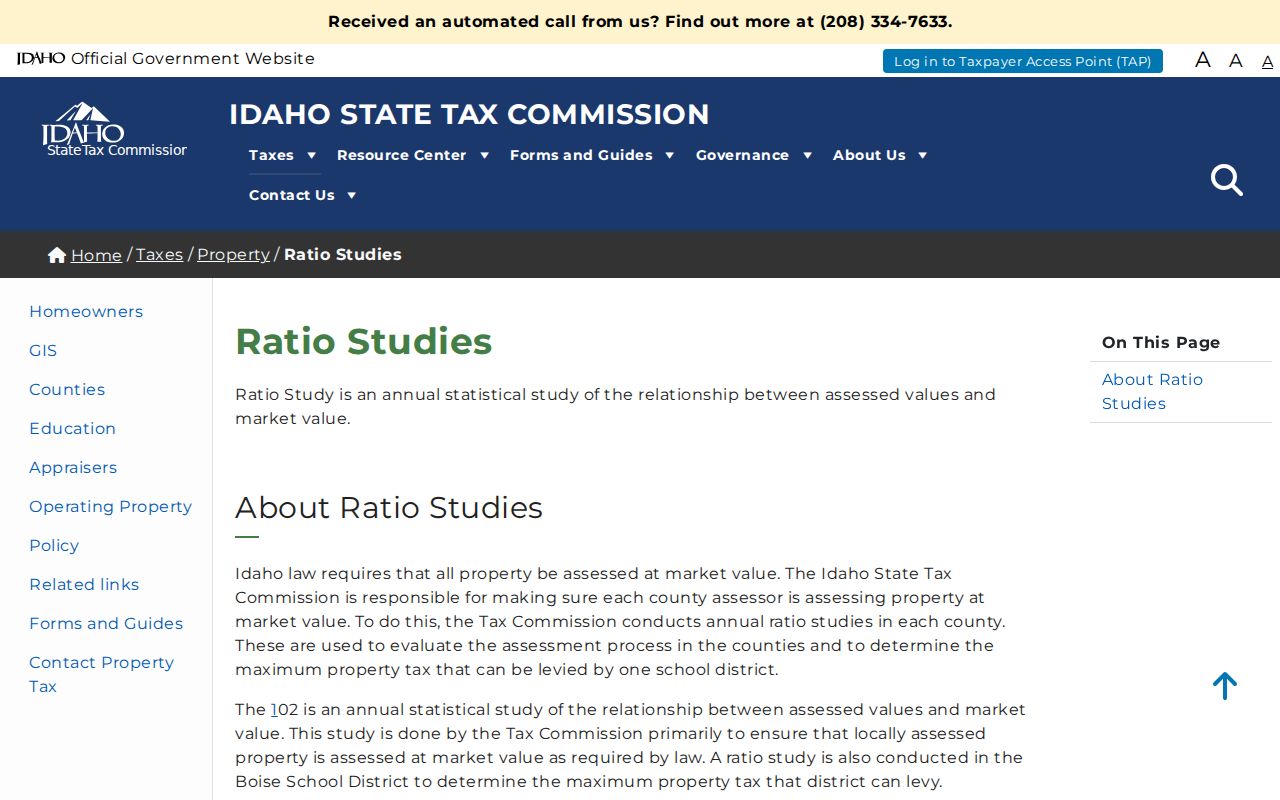
This state-level ratio-study material compares assessment patterns and sale prices. It does not assign an appraisal conclusion to one parcel.
The 2025 ratio-study manual describes sales from October 1, 2024 through September 30, 2025, adjusted to January 1, 2025. The study was completed in March 2026. The study period and completion date describe that report only. Cite the report year and scope when quoting a result. Do not carry its sale sample forward as a current price estimate.
Where Idaho Property Sale Prices Appear
A sale price is what changed hands, not what the assessor thinks. The recorded deed remains the anchor for confirming a transfer. Some county assessors also expose a sales-history field on a parcel. What you actually see varies by portal. A deed entry or history heading can prove a transaction exists while showing no consideration, or too little context to treat the figure as a clean market comparison.
Kootenai County shows this limit well. Its assessor detail carries a Sales History heading, yet the public sample does not display a stable sale price. The heading alone is not proof a price is visible. The Kootenai County Recorder holds recorded real-property documents dating to 1881, with online recorded documents from 1996 to present and older holdings available through office research. That cutoff belongs to Kootenai alone. Do not apply it to other Idaho counties.
When a price matters, capture the details first. Record the instrument number, the recording date, the legal description, and the source county. Then verify the instrument with that county's recorder. Sale history can explain a change in assessed value, though the two figures may differ because of timing, property condition, included land, or transfer terms. One sale is not a current asking price. It is rarely a universal comparable either.
Idaho County Assessment Sources
Idaho has 44 counties and no single statewide parcel-value search. The Tax Commission sends anyone seeking a parcel's assessment straight to the county assessor. It also publishes a contact list for every county. Portals differ widely. Fields, search rules, image access, and historical coverage all vary from one county to the next. If a search comes up empty, ask the county office about the proper identifier. Or ask about an alternate access route. The parcel may still sit on the tax roll.
Idaho Map serves as a statewide entry point for official geospatial data. Its standardized parcel layer helps locate parcels across counties. Its metadata describes coverage being built toward all 44 counties through data-sharing agreements. It is updated as counties supply their data. The item was last updated April 9, 2026. Missing or stale geometry is a coverage issue. It is not proof that no value entry exists.
The Tax Commission's parcel-map page links to county parcel sources, Idaho Map, and related services. It also states plainly that parcel-level authority stays with county assessors. Use the state layer to find a county resource. Then verify the assessment and its history in the local assessor record.
Limits of Idaho Assessment Estimates
An assessed value is a tax-system estimate. It rests on the parcel facts the assessor holds plus a market-value standard. A fast market can outrun it, so the number can lag. It is not a promise about a later sale. A last sale price may be older, may describe a different condition, and may not compare cleanly to the current property. Give each figure its own source, date, and context before you lean on it.
Value versus price. An Idaho assessor’s figure is not an individual sale appraisal and does not show what a property will sell for. For a transaction-specific opinion, use a qualified appraiser and current evidence.
Match the record to the question. The assessor holds assessed and taxable values. The recorder holds recorded transfer documents, and a qualified appraiser provides an individual market opinion. For the bill, relief, or challenge process, the route is county and year-specific. Follow the Idaho tax record route. Any property value number is evidence about one record. It is never a substitute for title, survey, or appraisal work.