
Tracing Former Idaho Property Owners
How far back former-owner research reaches depends on the county. It also depends on the record series involved. Write the source and year range beside every result. Idaho has no single continuous statewide deed index. Kootenai County shows how an office's holdings can differ from its online search window. Archival and digitized collections add county-specific paths for older periods. The coverage examples below are tied to named custodians.
They are not a promise that every parcel has a complete chain. Carry the date, both parties, the instrument type, and its locator for each transfer. The county examples describe access and coverage. They do not trace one property's ownership chain. Every name and date must come from the source being checked.
| Transfer Date | Grantor → Grantee | Deed Type | Book/Page or Instrument |
|---|---|---|---|
| Copy the date shown on the entry. | Transcribe both parties as recorded. | Copy the indexed document type. | Keep the locator shown by the source. |
| Use the earlier deed's date. | Follow the prior grantor as grantee, then read that deed's grantor. | Read the type on the earlier filing. | Retain the matched reference. |
| Use the date in the older volume. | Check the original party index and deed names. | Transcribe the volume's label. | Record the volume and page reference. |
| Source | Years or Coverage | Where Held | What It May Show |
|---|---|---|---|
| Kootenai online real-estate index | 1996 to present | County Recorder search | Recorded-document index and online research route. |
| Kootenai Recorder holdings | Real-property documents maintained from 1881 | County office and older-record request route | Older county documents beyond the online window. |
| Idaho State Archives | County land/property material from 1863 in relevant series | State Archives; series and access vary | Selected government records, not one statewide deed run. |
| Clark County digitized records | 1884-1998 collection description | FamilySearch; originals identified at Clark County Clerk | Land/property, deeds, grantor/grantee indexes, mining, patents, and probate. |
| Butte County deed catalog | 1880-1985 catalog description | FamilySearch catalog; courthouse originals identified | Digitized deed records and indexes described by the catalog. |
Begin with the recorder index in the county where the land sat. Step to local books or image series when the online period ends. The State Archives and digitized collections can add clues. Match the named county and date span to the parcel being researched. Do this before trusting any result.
Kootenai Online and Older Records
Kootenai County's Recorder holds real-property records from 1881 forward. The county's online recorded-document search, though, starts at 1996. That cutoff is a limit of one tool, not the start of the county record. Former owners named before 1996 may still appear in older holdings. For earlier Kootenai transfers, the county points researchers to office research beyond the online window. Never carry either date to another Idaho county without checking that recorder's own coverage statement.
The county's Records Research information describes free online viewing and routes researchers to older materials. A recorded-document request form offers a mail route for Kootenai filings. Office access, copy fees, and mail steps stay county-specific. The fees and process on the Idaho deed records page are Kootenai examples. They are not statewide rates or procedures.
Kootenai's current Records Research page separates online records from staff-assisted research. 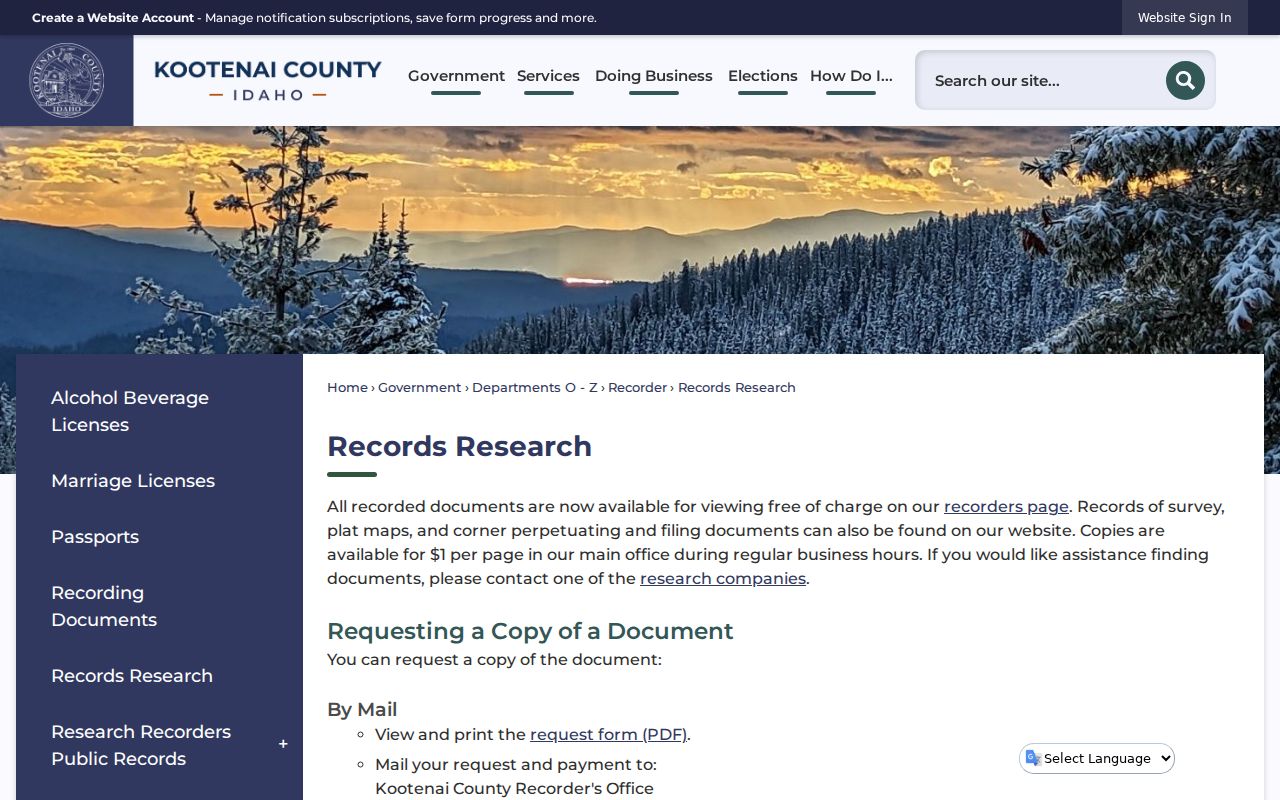 A search form can locate an indexed filing, while older book or film references may still need help from the county office.
How Far Idaho Ownership Records Reach
Idaho's land record trail crosses several eras. Federal patents and homesteads came first. Territorial and county books followed, along with tax and court records. Then came typed indexes, scanned images, and vendor portals. A former owner can surface in a series older than the county's current online search. The State Archives holds county land and property material dating from 1863. That date describes selected series only. It is not a claim that every county deed book begins that year. Nor does it mean one chain runs back without gaps.
Handwritten grantor and grantee ledgers sit behind a newer online system in many counties. So can deed books, tax rolls, plat volumes, survey and corner books, and microfilm. An index can also be more recent than the instrument it describes. Note the earliest date actually checked for each former owner. Record the source and where it stopped returning results. A later volume or a different name form may extend the trail.
Coverage is local. Kootenai's 1881 office holdings and 1996 online index are one county example. They do not define Idaho-wide coverage, and an online search with no earlier result does not establish that no older record exists.
Read Idaho Deed Chains Backward
Once an indexed transfer turns up, work backward. The grantee on that deed may appear as grantor on an earlier one. Each filing adds a prior owner. Keep the legal description, recording reference, and date beside every name, so the history stays tied to the same land rather than drifting into a list of people with similar names. That discipline is what separates a deed chain from a coincidence of surnames.
- Set aside the known deed's legal description, county, date, and reference.
- Read the grantee and grantor exactly as they appeared, including middle initials, entity names, and estate roles.
- Search the grantor as a grantee in an earlier date range, then compare the legal description and parcel references.
- Repeat with the earlier deed's grantor, marking any name change, split, exception, or replat that altered the land description.
- Stop at the source's date boundary and record what remains unchecked in office books, microfilm, or archival series.
- Grantor
- The person or entity that conveyed the interest in a recorded instrument.
- Grantee
- The person or entity named as receiving that interest.
- Chain of title
- The linked record of transfers and related instruments for the same land.
- Reverse index
- A search of earlier entries by a later holder's name, checked against the land description.
A straight sequence can break. An owner may have died, land may have passed through an estate, a tract may have been split, or a correction may have changed the written description. A broken index trail calls for a different source or identifier, not a guess about the missing transfer.
Idaho State Archives Holdings
The Idaho State Archives holds or provides access to state, county, and city government records. Its description covers county land and property, court, citizenship, and tax records among relevant series. The Archives reports roughly 40,000 rolls of microfilm, but that figure covers its broad holdings and does not mean every county deed book is on film. Check the catalog or staff guidance for the county, record type, and year before planning a visit; selected series may help extend a former owner's record trail.
The research room is in Boise and uses appointments; the Archives' current information lists Wednesday through Saturday service around 10:00 a.m. to 4:30 p.m. and prefers advance notice. Hours and access can change, so check the current page before traveling. Retrieval, scans, fax, certified copies, and reproductions can depend on the record series and may involve fees. These services are distinct from a county recorder's certified deed copy.
The Archives searchable indexes cover selected records and counties. An index entry is a pointer, not a deed image or complete ownership chain. Capture its source title and reference, then request or inspect the original volume when the series allows it.
Digitized Idaho County Collections
FamilySearch lists Idaho county land collections whose descriptions identify the local originals. The Clark County Records collection describes material dated 1884-1998, with originals held by the Clark County Clerk. The inventory spans land and property, deeds, grantee and grantor indexes, mining, patents, and probate, and the description reports 19,976 images. A former owners search in Clark County can gain real ground when the collection dates and land description line up.
The Butte County deed records catalog describes courthouse deed records and indexes covering 1880-1985. The catalog's current access route shows whether a listed record opens as a digital image. The Idaho FamilySearch collection list can be searched for other holdings. Include a collection only when its record description names the county and the original series.
These county examples prove no general coverage. Another county may rely on a different partner, a different date span, an image restriction, or no digitized deed set at all. Keep the collection citation and the note about the original custodian, since an online image should always trace back to the local record series it came from.
Probate and Other Chain Breaks
Death often moved land through an estate before a personal-representative deed reached the recorder index. The probate case and the deed are separate records. Different offices hold them. A tax deed, sheriff deed, patent, homestead claim, mining transfer, or court order can also pass title in ways that look nothing like an ordinary sale. Study the instrument type. Never assume every former owner signed a warranty deed.
When an index jumps from one name to another, hunt for a related probate, court, tax, or land record from the same county and period. State court information runs through Idaho MyCourts. Public case information is not a deed image, though. Sealed or exempt records may never appear there. A courthouse kiosk or the clerk where the case was filed offers another route to available court records.
Trusts, personal representatives, predecessor businesses, and entity names change how a party appears in the index. Record the exact name from each instrument. Note the role shown beside it. The aim is to explain each handoff with source documents rather than smoothing over a gap with assumptions.
Historic Names and Parcel Changes
Old deeds rarely use today's street address. Expect a former county, post office, precinct, mining district, township description, homestead claim, or nearby landmark instead. Streets get renamed. City boundaries shift. A parcel number changes after a split or replat. Keep the original wording in your citation, then add a separate note with modern equivalents so the search stays auditable.
Plats, surveys, road dedications, and subdivision changes connect a former lot to its parent tract or later parcel. A current GIS map helps orient the search. A polygon proves no historic boundary. The recorded plat, deed language, and survey or corner records give stronger evidence of how the land was divided.
Directories and newspapers can explain a name or address change. Neither establishes title. Boise directories run from 1899 to the present in Archives material, and the Polk Boise directory catalog lists annual issues through 1994, including Ada taxpayers, Garden City, and Meridian. That local clue can bridge a former owner to an address and year. Ownership evidence still comes from the recorder. Treat the directory as a lead, not a deed.
When an Idaho Search Reaches a Gap
A clean "no result" still tells you something. Write it down exactly: the named county index showed no match for that name, parcel description, and date span. Say it only for the search date. Spelling changes can hide a match. So can a different index volume, a portal cutoff, or an unscanned image, and none of those gaps prove that former owners or recorded instruments never existed.
For older years, ask the county office which book, film, or local series continues past its online index. Then check the State Archives and any digitized collections. If no earlier collection is identified for that county, state the gap plainly. Borrowing Clark or Butte dates would only mislead. Keep a simple trail of source, query, period, and next custodian. A careful stop point beats a false complete history.
Note: Former-owner research is suited to house history and property diligence; use records lawfully and respect privacy and safety limits.
Need a copy of a single deed you located? The county-specific routes appear with Idaho's deed records and request options.