
Idaho Deed Records and Instruments
Idaho deed records live at the county level. Every county recorder keeps the land documents for land inside its borders. No statewide index gathers them in one place. A search can run by owner name, property location, or a known document reference, and many people search Idaho deed records by county for exactly that reason. Start with the right county. Then compare each result against the legal description before trusting it. A recorded document might be a deed, a lien, a release, or another instrument. Each tells you only what was filed. Copy costs, online access, and how far back the records reach all vary by county.
| Deed or Record Type | What It Does | Common Research Use |
|---|---|---|
| Deed | Records a transfer of an interest, as stated in the instrument. | Identify parties, date, parcel description, and transfer terms. |
| Deed of trust or mortgage | Records a security instrument tied to a debt. | Find the related release, assignment, or reconveyance. |
| Reconveyance or release | Records that a secured interest was released or reconveyed. | Check the land record after finding a prior loan instrument. |
| Easement or right-of-way | Records a use or access interest affecting land. | Read access, shared-road, utility, or boundary context. |
| Tax, sheriff, or patent deed | Records a transfer through a distinct public process. | Follow a tax sale, court action, or original land grant. |
| Plat, survey, or corner record | Records land division or boundary evidence, not a deed transfer. | Match lot, block, access, and survey references to a deed. |
Recorders also file liens, assignments, corrective instruments, and powers of attorney beside the conveyances. Read the document type together with the legal description. A name match alone can blur two people or two parcels that merely look alike.
Idaho Recorder Search Fields
County portals differ. The Kootenai County Real Estate Search illustrates the search keys a local index may accept. The county's Recorder information page explains party, instrument, and legal-description searching. The live search may require an interactive session. A static page will not display every control or result field.
| Field Label | Type | Required | Options or Format Notes |
|---|---|---|---|
| Party name | Text | Search mode | Search as grantor or grantee; spelling and entity form matter. |
| Instrument number or book/page | Text | Optional locator | Use a known reference to open a specific record. |
| Legal description | Text or search concept | Search mode | Use parcel, lot, section, or other description terms where supported. |
| Recording date | Date or range | Optional | Narrow a name search when the date is known. |
| Document type | List or search concept | Optional | Separate transfer instruments from plats, surveys, liens, and releases. |
Kootenai's public index opens through the county's Real Estate Search entry. Search tools are county examples, not a statewide service. 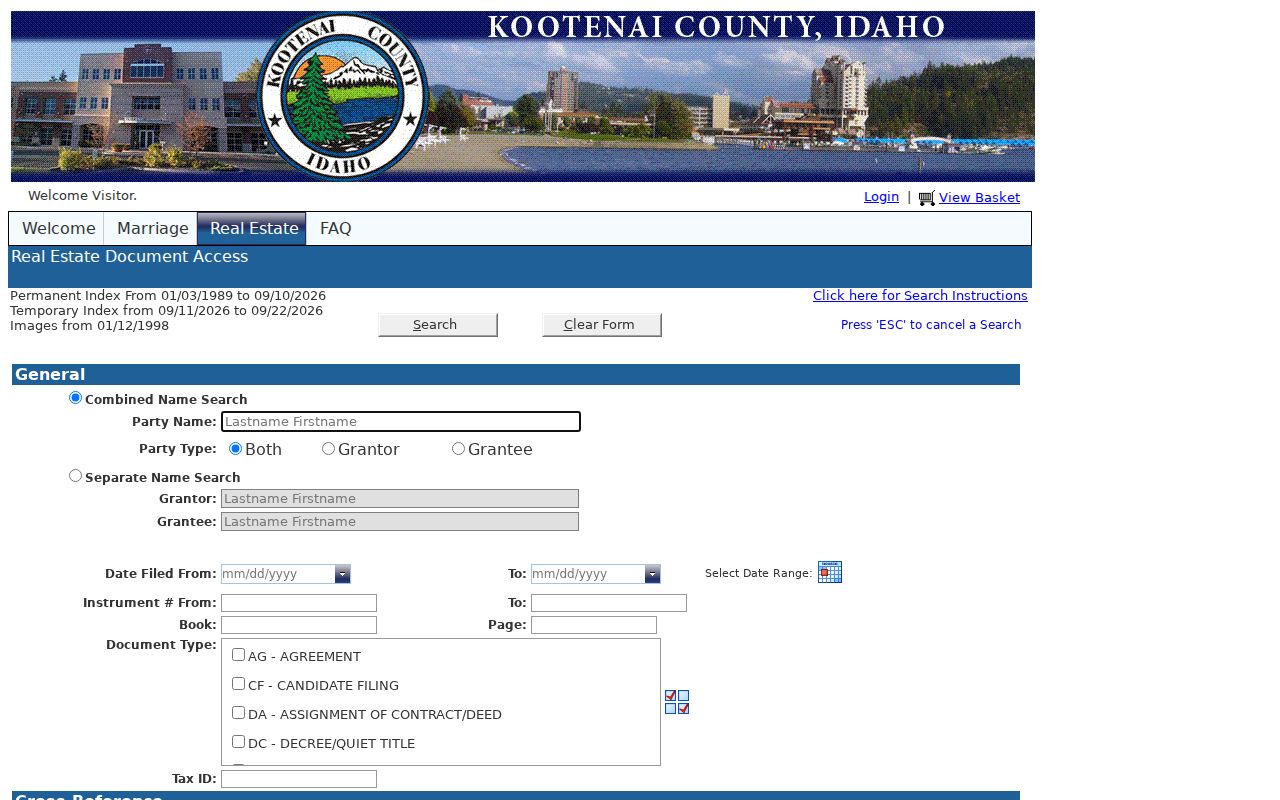 These visible search concepts can help identify a route, while exact filters and image access may change after the portal loads.
Search Idaho Deed Indexes
A grantor conveys the interest. A grantee receives it. County indexes often allow a search in either direction. Start from the property's identity, then check both names and the legal description so one transfer stands apart from a record that merely sounds similar.
- Use the county assessor or an existing parcel record to note the county, owner name, parcel identifier, and full legal description.
- Search the recorder index for the owner as grantee, using a date range or instrument number when known.
- Compare the returned party names, document type, date, and legal description before treating a result as the right deed.
- Check related assignments, releases, easements, liens, corrections, or later conveyances when they bear on the record trail.
- Record the index's coverage limit and the reference needed to locate the image or paper volume.
- Grantor
- The party shown as conveying the interest.
- Grantee
- The party shown as receiving the interest.
- Chain of title
- The ordered set of recorded transfers used to follow an interest through time.
- Book and page
- A volume and page reference; an instrument number is a separate identifier assigned by a recording system.
Party indexes can miss spelling variants, changed business names, or a transfer filed under an estate representative. The full legal description and the original instrument remain the real checks. For tracing earlier owners of a parcel, the Idaho former owners record trail offers a focused path.
What Idaho Deeds Do Not Prove
A recorded instrument shows what was filed and indexed. It is evidence to review, not a legal opinion on title. A deed alone may not expose an unrecorded claim. It may also miss a later correction or an interest carved out of the description. Nor can it confirm that every link in the ownership record is complete. The same caution applies to maps. A GIS outline or assessor entry never replaces a recorded plat, survey, or deed. That rule holds when a boundary or legal interest is disputed.
Recorded does not mean guaranteed. Compare the complete instrument, legal description, and related filings. A name or online result is not a title determination, and a missing index hit is not proof that no instrument exists.
Use the recorder's index to locate filed documents, then ask the correct county office about an unclear image or reference. Priority, legal reliance, and the effect of a lien may turn on the actual instrument and applicable law.
Idaho County Coverage Varies
Idaho's recorder system is local by design. One county may offer an online party index. Another may offer a vendor search. And another relies mainly on an office kiosk or a written request. The state publishes no statewide recorder database. The Idaho Tax Commission's property tax contact directory helps route assessor or treasurer questions. It is not a deed index, though. Confirm which county holds the land before searching.
Kootenai County shows a gap. It is the gap between what an office holds and what its online search displays. Its Recorder maintains real-property documents from 1881. The online recorded-document search covers 1996 to the present. Those dates apply to Kootenai County alone. They say nothing about coverage in another county. The Kootenai records research page describes free online viewing. It also points older holdings back to the office.
Read any Idaho search result with the portal's county, date, and image limits in mind. A newer online index often sits above an older paper or microfilm series. The online start date is never the date the county began keeping records.
Request Idaho Deed Copies
Need a deed image? Start with the county recorder's online index and follow its document link. When the image is missing, or a certified copy is required, the county's counter or written request process is the fallback. Kootenai's request form covers party names, recording dates, and instrument or book/page references. It also takes legal-description details and asks who is requesting the document, plus a return contact. Those fields matter because staff often cannot find a filing from a street address or a person name alone.
Fees depend on the county and the copy type. Kootenai reports free online viewing and $1 per page for copies. Certification adds another $1 per document. Its research page notes that a mailed return may need a self-addressed stamped envelope, or $1.50 for postage and handling where required. A separate county fee table prices conforming copies at $0.50 per page. Since more than one copy category exists, confirm the format and current schedule with the office before paying. All of these are Kootenai figures, not Idaho-wide rates.
The county's recorded-document request form lists every field and submission detail. It allows up to three recording dates. It also asks for subdivision, section, lot, township, block, or range details where they apply. Counter access, mail instructions, certification, and return postage differ from county to county. Keep whatever reference number comes back, along with the search date and index range, so the same Idaho property records query can be repeated later.
Idaho Recording Requirements
Searching Idaho deed records is one thing. Recording a new instrument is another. Kootenai County's instructions say submissions must be original, complete, signed, and notarized. They should also include a legal description or a reference to a related recorded instrument. The county accepts mail and in-person submissions and names approved electronic recording vendors. That workflow belongs to one county, so treat it as a published example rather than a statewide checklist.
Each recorder sets its own directions. Before filing anywhere in Idaho, check that county's current rules for document type, form, fee, and delivery route. The Kootenai recording documents page lays out county-specific fee categories and vendor routes. Its examples include $15 for deeds, $45 for deeds of trust or mortgages, $15 for reconveyances, and $11 for plats. Charges for other document types and extra pages appear on the same page, so a short sample is never a full quote.
Schedules change and vary by instrument. Do not carry Kootenai's amounts into another county. Nor assume an online copy price equals the cost of recording a new deed. A rejected or incomplete filing can delay the entry in the public property records index, so the receiving county's current instructions always control.