
Find Who Owns Idaho Property
Start with the county. Idaho property records live in local offices rather than one statewide assessor portal. No single owner card covers the whole state. The practical route runs from an address to a parcel, then from that parcel to a tax-roll name and the deed behind the transfer. A county GIS map helps you locate the parcel first. Its label is only a locator, though, not proof of title. For the name itself, turn to the assessor's roll. That roll ties an owner of record to each parcel number. Then search the recorder's deed index. The latest deed shows the grantee. That name is the one a transfer actually supports.
- Search the property address in the county assessor’s portal. If the address is unclear, use the county GIS to identify a parcel number or legal description.
- Open the assessor card and note the owner field, parcel key, situs address, mailing address, legal description, and any last-updated date.
- Search the county recorder’s real-estate index for the parcel’s latest deed. Compare the named grantee and legal description with the assessor entry.
- If the grantee is a company or trust, check the relevant filing or court record for context. Those records can explain a name, but they do not replace the deed.
This route answers the plain question of who owns a property in Idaho without mistaking one database label for the whole record. Every owner field has limits on how current it stays. For those details, see the Idaho current-owner record.
Where Idaho Owner Records Appear
No one office answers every question. The assessor links each parcel to its tax-roll owner and property details. The recorder keeps the instruments accepted for recording. A GIS map places parcels geographically. A state business filing can surface the people behind an entity that shows up as a grantee on a deed. Idaho offers no unified owner search that merges these sources. Counties also update on their own schedules. Results can differ from one office to the next.
| Record source | What it can show | How to reach it |
|---|---|---|
| County assessor | Tax-roll owner, parcel key, situs and mailing addresses, legal description | County assessor portal or office |
| County recorder | Grantee and legal description on a recorded deed | County index, image system, kiosk, or request |
| County GIS | Parcel shape, map label, neighboring lots and map layers | County map or Idaho Map |
| Idaho SOSBiz | Public business filing details for an entity name | Secretary of State business search |
"Owner of record" means the name entered on an office's record. It does not mean that person occupies the site. A mailing address may simply be where tax notices go. A map label may come from an assessor feed rather than a fresh deed image. Read each result by its source and date. The tax-roll name and the deed grantee are related clues. The two records can update on different schedules. So a property owner may appear differently in each.
Read a Kootenai Owner Card
Kootenai County offers a handy Idaho example. Its assessor portal lets you pull up a parcel several ways: by parcel number or PIN, by owner, by property address, by AIN, or by legal description. Those fields belong to this county alone. Parcel formats and search screens vary across Idaho counties, and update schedules differ too. A number length or button label here tells you little about the next county over.
The county's official assessor detail record places the owner name beside the other identifying fields on one screen. Treat it as a field example. It is not a statewide form.
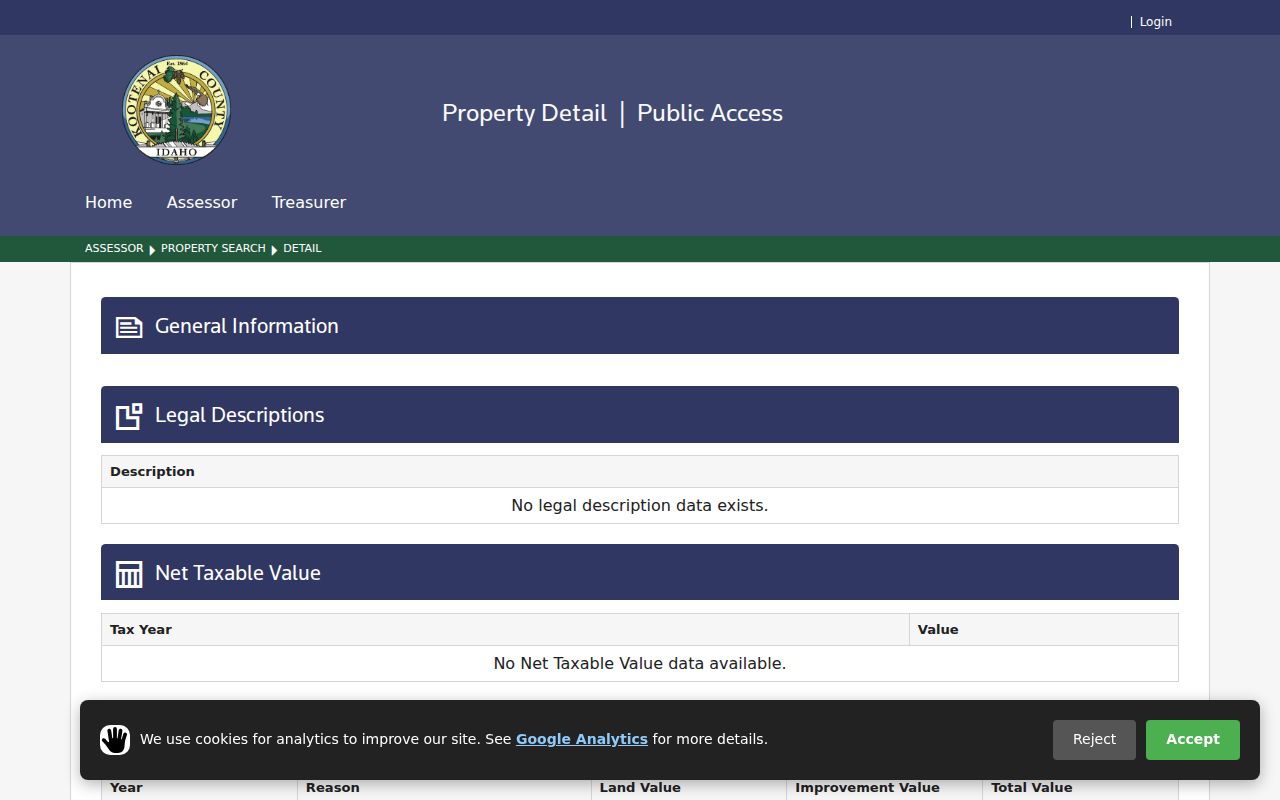
The Kootenai sample parcel card packs in plenty. Owner, situs and mailing address, PIN, AIN, legal description, neighborhood, tax district, property class, deeded acres, and a last-updated field all appear together. Its detail view goes further. It adds taxable value, value history, exemptions, land, improvements, permits, and sales history. That depth helps separate one parcel from a similar one. It can also distinguish a lot next door. Still, it cannot prove no later deed exists. When a recent transfer matters, check the recorder's deed index too.
Match Idaho Mailing and Site Addresses
A situs address tells you where the parcel sits. A mailing address tells you where the assessor or treasurer sends notices. The two often differ for ordinary reasons. An owner may get mail at another home or office. An entity may list an agent. Or the parcel may lack a conventional street address. A mismatch is a prompt to read the record closely. It is not proof the assessor named the wrong owner of record.
Keep the two address types apart in your notes. Log the situs address, mailing address, parcel number, and legal description as separate fields. A GIS map may show one address. The tax roll may show another. Confirm both records describe the same parcel first. A rural route, a unit number, or a street suffix can make two valid records look unrelated. A renamed road can do the same.
- Owner of record
- The name shown by a particular public custodian for its record or tax roll.
- Grantee
- The person or entity receiving an interest in a deed.
- Situs address
- The location address assigned to the parcel.
- Mailing address
- The separate address used to send tax or property notices.
For a boundary or lot-number question, compare the assessor's legal description with the recorded plat or deed records rather than trusting the postal address alone.
Check Idaho Company and Estate Names
Deeds in Idaho do not always name a person. The grantee line may list an LLC, a corporation, a trust, an estate, or a personal representative. Read that wording first. It tells you what kind of owner record you are chasing. When a business entity appears, the Idaho Secretary of State's SOSBiz search shows its filing status and public filing details. Registered-agent or officer information may appear there where available. Those names help explain the entity record. They do not prove who owns the real property. Nor do they prove who may sign for it today.
Estate transfers raise a second wrinkle. Probate filings and a later deed may both play a part. Idaho's iCourt public search is a starting point for state case information. A case result, though, is not a recorded land instrument. Access and coverage depend on the case and portal. If a probate order looks relevant, take its case number to the county recorder's index. Then connect the order, or the representative's deed, to the parcel.
Never infer an individual owner from an entity name alone. Keep three things separate: the direct deed grantee, the assessor's tax-roll name, and any business or probate context. That separation preserves the difference between a legal instrument and background filing data.
Note: An entity filing and a property deed are different records. One does not substitute for the other.
Build an Idaho Parcel Identity Packet
Names and addresses shift over time. Before you search more offices, gather a small set of stable identifiers for the land. This "identity packet" keeps you from joining two different parcels. That mix-up happens easily when records share a street name or an owner spelling. Save the source beside each item. An identifier only helps if it points to the same parcel across records. Label each key with its county and date.
- County and current or former situs address
- Parcel number, PIN, AIN, or other county key
- Legal description, subdivision, lot, and block if shown
- Owner-name variants and the exact deed grantee spelling
- Recorder instrument number, recording date, and source link
Kootenai shows why more than one key matters. Its assessor exposes a 12-digit PIN and a six-digit AIN. Legal-description and owner searches are offered there too. Keep those formats labeled "Kootenai." Copying them into another county's search invites confusion. If an address lookup returns nothing, try a parcel key or legal description. That way you avoid concluding the land is missing from the property records.
When an Idaho Owner Search Misses
A failed search proves very little. It does not establish that a property has no owner or no deed. First confirm you picked the right county. Then try the parcel key or the legal description. Strip punctuation from a parcel number if the county portal wants it that way. Test a shorter spelling of an owner or street name. Kootenai's assessor search tips include spelling out the street. They also suggest using an asterisk as a wildcard. Those instructions fit that portal, not every Idaho system.
Next, ask which record you actually searched. A statewide parcel layer may omit a county or lag its latest update. Coverage depends on data sharing and county refreshes. A recorder index may carry a date cutoff or require a separate image search. Idaho Map works as a cross-county discovery tool. The Idaho Tax Commission points users back to the county assessor for parcel-level authority. The responsible county is sometimes unclear. In that case, the state's county clerk directory helps identify the local office.
Write a negative result narrowly. Name the portal, the county, the search key, the date range, and the date searched. "No matching entry in this county index for this name and period" beats "there is no deed." That narrower phrasing wins every time.
Limits of an Idaho Owner Lookup
A tax-roll name is a solid owner lead. It is not a title opinion. The owner may have changed after the assessor's last update. A deed may carry a complex legal description. The parcel may also have split or merged. For a stronger record trail, follow the recorder's latest deed and related plats. Then check any later correction instruments. Even those public records do not reveal who lives at a property. A neighbor or occupant is not the owner of record.
Some address information is protected by design. Idaho's Address Confidentiality Program gives qualifying survivors a substitute address along with confidential voter-record protections. Do not try to connect protected information back to a residence through another record. A hidden or substituted address marks an access boundary. It is not an invitation to investigate around it.
Use owner details with care. Public property data can support lawful ownership research, boundary work, and civic review. Do not use a name or address to watch, threaten, harass, or target a person.
For the recorded transfer itself, follow the Idaho deed-record search route. Confirm the instrument with the county that holds it.