
Idaho Property Tax Record Fields
Two county offices shape Idaho property tax records. The assessor tracks value and exemptions. The treasurer bills and collects. Idaho keeps no single statewide parcel tax account. Every lookup starts with the county holding the parcel. An address, owner name, legal description, or parcel number can open a record. Search fields vary by county portal, though. A statewide contact list helps route requests and explains the broad rules. You can search Idaho property tax records by county. Start once you know where the parcel sits. A record explains a value or balance. It never proves title or replaces a current county notice.
| Field | What It Shows | Where |
|---|---|---|
| Market / assessed value | The assessor’s estimate under Idaho’s market-value standard, before tax relief is applied. | County assessor |
| Exemptions and net taxable value | Relief entries and the taxable base left after qualifying exemptions. | County assessor |
| Levy and taxing districts | Rates and district components used to work out the bill. | County tax record; clerk or auditor roles vary |
| Bill, payment, delinquency | Amount billed, payment credit, balance, or past-due status. | County treasurer |
| Tax lien or tax deed | Balance and status come from the tax account; recorded filings need a separate instrument check. | Treasurer for account; county recorder for instrument |
Idaho assessors set a parcel's market value using the January 1 standard the state applies. An exemption can lower the net taxable value. That net figure is what levy rates multiply against. The resulting bill is the amount due on the parcel to its taxing authorities. Keep the concepts apart. A bill is not a sale price. A paid tax tells you nothing about any recorded deed, release, or title finding. To get oriented, the Idaho property search pinpoints the county and parcel number. Then you can weigh the assessment against the bill.
Idaho Tax Portal Search Fields
County portals differ, so treat any field table as one practical example. Kootenai County's treasurer search accepts a PIN, AIN, primary owner, property address, or mailing address. Its assessor search offers separate modes. These cover parcel number, owner, property address, AIN, and legal description. These details are Kootenai-specific. Another Idaho county may use different labels. It may also require different input or expose a different range of years.
| Kootenai field | Input | Search note |
|---|---|---|
| PIN / parcel number | 12-digit county identifier | For assessor PIN mode, enter the full PIN and remove dashes; the treasurer also accepts PIN or AIN. |
| AIN | Six-digit alternate ID | Use the full number shown on the county record. |
| Primary owner | Name text | Assessor guidance says last name first; less text or an asterisk wildcard can broaden matches. |
| Property / mailing address | Street text | Street spelling matters; assessor guidance says to spell out “Mountain” rather than assume “Mount.” |
| Legal description | Subdivision and lot, or section-township-range terms | Use it when the street address is unclear; exact interactive subfields are not fully shown in the static page. |
The Idaho Tax Commission's county property-tax contact list is the statewide starting point. It routes a researcher to local assessors and treasurers. The Commission notes it holds no specific parcel information. Use the county portal for an online search. Then contact the county custodian if a field, older bill, or current balance is missing. This example shows the account lookup screen. The Kootenai County treasurer search is the source.
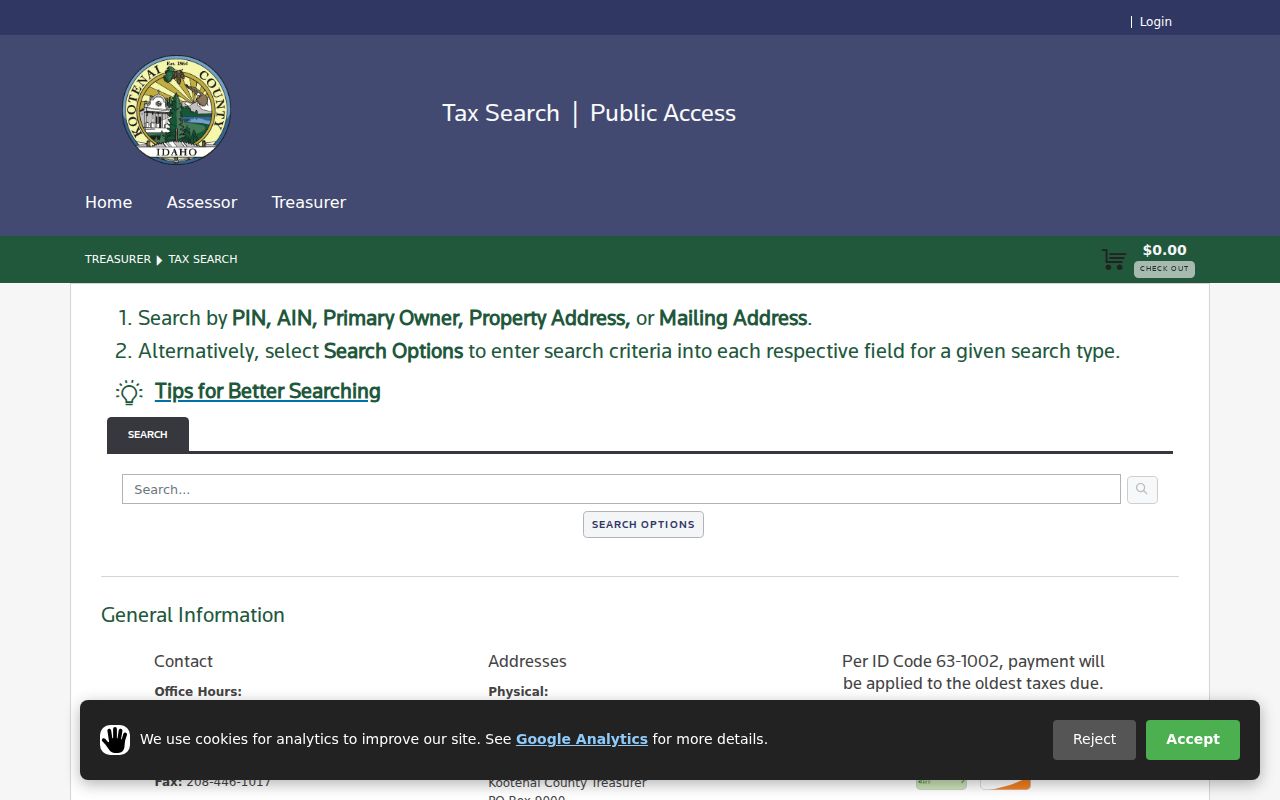
These fields belong to Kootenai County's interface. Use the local county route for any other Idaho parcel.
Find an Idaho Property Tax Bill
Once the county and parcel are known, start with the treasurer. Idaho property tax records put the current bill and payment status on the treasurer's side. Assessed value and exemptions usually sit with the assessor. In Kootenai County, the public treasurer portal offers PIN, AIN, primary-owner, property-address, and mailing-address routes. Its static page states no full historical cutoff. Confirm older bill years with that county. Do not assume they are unavailable.
- Find the county through the Tax Commission contact list, then open that county’s official treasurer search.
- Search by address, parcel ID, or owner if that mode is offered; record the query and the parcel identifier returned.
- Read the tax year, amount due, credits, and payment status. Compare an exemption or value question with the assessor record.
- If a balance is delinquent, ask the treasurer about the account status and check the recorder or court for any later collection filing.
- Assessed value
- The assessor’s value estimate under Idaho’s market-value assessment standard.
- Net taxable value
- The tax base after eligible exemptions are applied.
- Levy
- A taxing district’s rate, tied to its budget and taxable base, that contributes to the bill.
- Homestead exemption
- Relief for a qualifying primary residence, claimed through the county assessor under current rules.
- Tax lien
- A legal claim tied to unpaid tax; check the official account and any recorded instrument before drawing a conclusion.
Kootenai County's treasurer applies each payment to the oldest taxes first. Processing can add fees. Neither that rule nor the fee behavior should be assumed for every county. Save the bill or confirmation with its date, tax year, parcel ID, and status. A later screen change cannot blur what you checked.
Idaho Assessment and Billing Calendar
Idaho's general property-tax explanation anchors the assessor's estimate to a January 1 market-value date. Notices generally go out around the first Monday in June. Tax bills are generally mailed in November. The first half is due December 20. The second half is due June 20. These are statewide calendar descriptions, and a current county notice controls any local change or exception.
At the state level, personal-property declarations are generally due March 15, and changes from exempt to nonexempt property are addressed around the first Monday in November. Those entries are not a real-property tax bill. A parcel's relevant notices can depend on its classification and exemption status, so keep the notice naming the parcel and tax year rather than relying on a calendar summary alone.
Assessment and payment move through distinct steps. The assessor sets parcel value and the exemption record. District budgets and the taxable base inform levy rates. The treasurer then issues and accounts for the bill. A change in one part can affect a later number without touching the prior payment record. For current dates, begin with the Tax Commission's Idaho property-tax explanation, then confirm with the county.
Note: County notices and current tax-account screens control over general calendar language when a local date or parcel status differs.
Idaho Exemptions and Tax Relief
Exemptions explain a common puzzle. Net taxable value often sits below the assessor's assessed value for a qualifying parcel. Idaho recognizes homeowner, agricultural, charitable, religious, government, and veteran exemptions, among others. Property class alone proves nothing. The county assessor handles applications and continued eligibility checks. Each county sets its own documents and processing route for the relief type involved.
The homeowner exemption covers a qualifying primary residence plus up to one acre, and it shields 50 percent of that value. The cap was $125,000 for 2021 through 2025. That figure is period-specific. Confirm the current amount on the state page and with the county assessor before relying on it for a later tax year. Ownership or residence changes can end it.
Property Tax Reduction is separate. It is an annual application with residence, ownership or occupancy, income, and other conditions. The 2026 window ran January 1 through April 15, 2026, and has closed. Listed benefits ranged from $250 to $1,500. Check the next cycle's dates and figures on the Idaho property-tax relief page. A tax deferral carries its own requirements and deadline, so do not mistake it for an automatic bill credit.
Appealing an Idaho Property Tax Assessment
A dispute starts with the assessment notice. File with the county Board of Equalization. The county clerk receives the filing. Idaho's general calendar sets the deadline at the fourth Monday in June. Hearings run through the second Monday in July. An appeal needs a clear request. Support it with parcel-specific evidence, such as comparable sales, photos, or income and cost records where they fit the property. No outcome is guaranteed.
Kootenai County's form shows what one county requests. It asks for one parcel per form, the parcel number and AIN, owner and contact information, and the current January 1 land, improvement, other, and total market values. The owner proposes new values. Reasons, evidence, hearing preference, and representative details follow, ending with a signed certification. That form is a Kootenai example, not a statewide standard. Use the current form from the county that issued your assessment.
Kootenai County, 2026 only. The county’s 2026 form required filing or postmark by 5:00 p.m. on June 22, 2026, and hearings were to be complete by July 13, 2026. Those dates have passed. They are not a current statewide deadline; confirm the next date with the county assessor or clerk.
Keep copies of everything. Save the notice, appeal, exhibits, and delivery record. An unfavorable county board decision is not the end. A State Board of Tax Appeals or district-court route may follow within 30 days, depending on the action. Read the decision letter. The Kootenai 2026 property assessment appeal form is a useful model of the fields, but do not reuse it as another county's form.
Idaho Delinquent Tax Records
A past-due balance is a starting point. It is not proof of a tax deed or a clear-title transfer. The treasurer's account shows delinquent years, amounts, penalties, notices, and redemption or payment status. The county recorder holds a different view. Recorded tax liens, tax deeds, certificates, redemption instruments, sheriff's deeds, and foreclosure filings all sit in the land records. Releases sit there too. A court docket may reveal an enforcement or foreclosure case. A public notice can carry a sale or redemption notice.
Match the record to the question. A treasurer screen answers what the tax account shows. A recorded instrument answers whether a document entered the land records. A court file answers what happened in a case. Idaho Tax Commission guidance explains that unpaid tax can lead to collection action. For case searches, start with Idaho MyCourts. Then ask the filing-county clerk about documents or access limits. Never infer a sale date, redemption outcome, or title result from a balance alone.
For an unresolved parcel, work the offices in order. Ask the treasurer which years and notices remain open in the account. Then check the recorder for later filings and the court for any case. Kootenai County's Recorder office is one county example. Idaho publishes no single recorder portal covering every county. No statewide calendar gathers sale notices and schedules either. Use the county website or the newspaper that county names. Verify any redemption status directly with the custodian.
Note: A delinquent balance is an account status; a lien, tax deed, court judgment, and title status require their own record checks.
Idaho Tax District Levies
More than one taxing authority can appear on a single Idaho property tax bill. City, county, school, fire, library, cemetery, highway, urban-renewal, water, sewer, and other districts each add a levy component depending on where the parcel sits. Kootenai County lays out the division of labor cleanly. The assessor sets values, the clerk calculates taxing-district budgets against total taxable value, and the treasurer handles billing and collection. Elsewhere in Idaho, those clerk, auditor, and assessor duties may differ.
A levy is simply the link between a district's budget and the taxable base inside that district. That explains why two parcels of similar value can carry different bills. Different districts, or different exemptions, change the math. To read one Idaho property tax record, line up the parcel's district or tax code area, its exemption entries, net taxable value, levy, and bill for the same tax year. One county's tax-district label is never a statewide format.
Payment status lives with the county treasurer. Value and exemption questions belong to the assessor. The Tax Commission's statewide contact list links to each county's local offices, so either route starts with one click. Bill question? Use the treasurer. Valuation or exemption question? Ask the assessor. When the value side of the record needs its own explanation, see the Idaho property value explanation.